
Art Reviews, Gallery & Exhibition visits, Art Conversation and Book reviews
EXHIBITION REVIEW
Dulwich Picture Gallery, London
’BERTHE MORISOT – SHAPING IMPRESSIONISM’
31/3/23-10/9/23 DATE OF VISIT 17/8/23
This exhibition, in partnership with Musee Marmottan Monet, Paris contained over 40 of Morisot’s works in paint and chalk/pencil/pastel. There were other works from artists such as Fragonard which hung next to Morisot’s paintings as comparison.
The display highlighted the way Morisot’s art transformed over her career. She was a major force in the Impressionist movement often playing an important role in exhibiting and organising their independent exhibitions. You can see the influence of Manet and Degas in her figurative work initially in paintings such as ‘At The Ball’ 1875. As her painting developed her figures and particularly her backgrounds became much looser in style – see ‘Children at the Basin’ 1886 – almost becoming abstract in appearance. Some of the paintings later in the exhibition from towards the end of Morisot’s career are almost a lead-in to Post-Impressionism or Expressionism in the way the figures are formed and colours used see ‘Julie Manet and her Greyhound’ You leave the exhibition kind of in awe of the way Morisot continued to produce work in the face of family and establishment discouragement. She excelled at illustrating the simpler things in life like domestic scenes and peaceful landscapes in a ‘ahead of her time’ way to become a hugely influential artist to future movements and beyond.
EXHIBITION REVIEW
John Singer-Sargent
‘Sargent & Fashion’
TATE BRITAIN, LONDON
22/2/24 – 7/7/24 Date of visit 11/5/24
This exhibition, in association with The Museum of Fine Arts, Boston, was made up of close to 60 of Sargent’s society portraits with associated costumes displayed alongside.
What a delight to see Sargent’s genius mix of uncanny likeness with faces and much looser brushstrokes with clothing and background. It is easy to understand how members of high society were literally queuing to have Sargent paint them. Having him do your portrait became the ultimate ‘must have’ and became a way of advertising wealth and status.
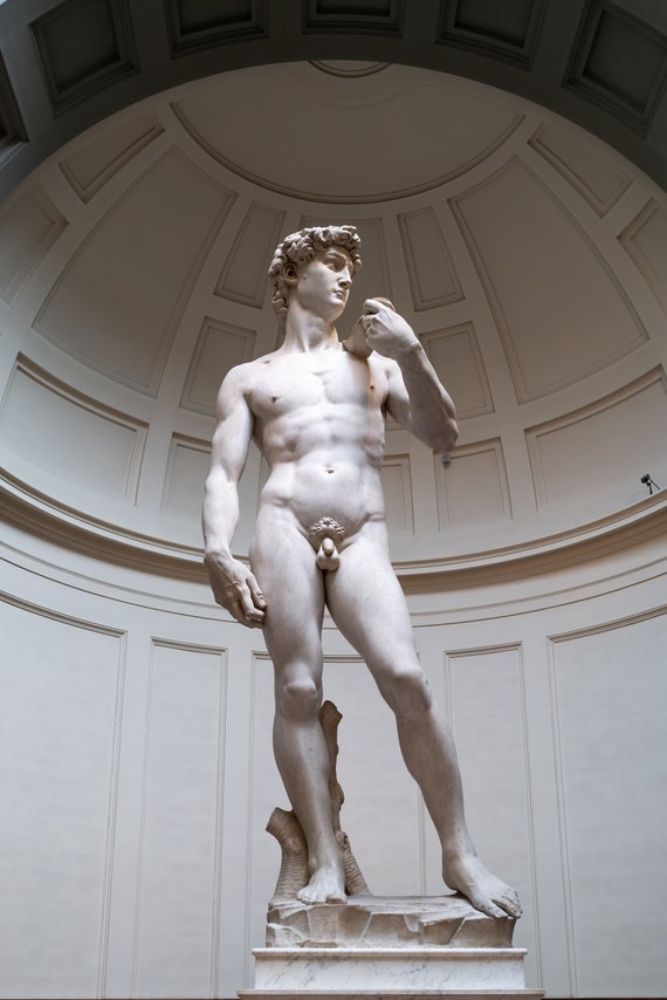
‘David’ Michelangelo 1501-4 Galleria dell’Accademia di Firenze
At 5.17 metres (17 feet) tall this statue, carved from a single block of marble, stands inside the Galleria dell’Accademia di Firenze in Florence. Originally other sculptors were approached to fashion the statue from the block but very quickly gave up saying it was impossible. It took Michelangelo the best part of 4 years to complete (1501-4), having to twist and reposition parts of the body to be accommodated in the marble. It was originally proposed to position the statue high up on the city cathedral’s roof but on seeing it for the first time officials realised it was too good to put out of easy eyeline so was erected outside the Palazzo Vecchio (City Hall).
By the late 1800s, due to weathering and minor cracking, it was moved inside to the where it stands today and a full size replica has been put in its original position.
As a footnote Queen Victoria was sent a full size replica of the statue by the Italian authorities as a consolation for missing out on securing a painting for her collection. This replica stands in the Victoria & Albert Museum, London and has a detachable fig leaf used to guard against the Queen’s shock at the nudity!
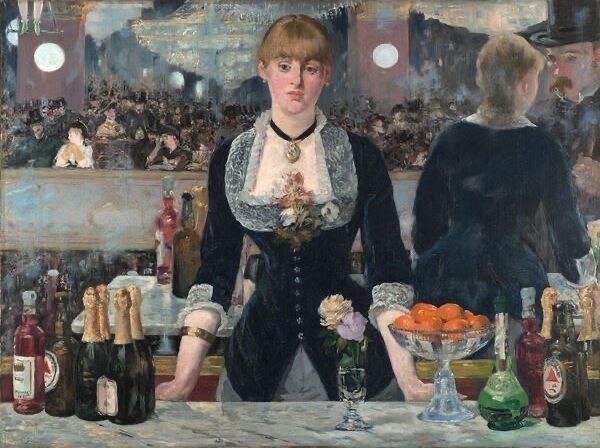
‘A Bar at the Folies-Bergere’ Edouard Manet 1882 The Courtauld Institute, London, UK
Edouard Manet (1832-1883)
Manet is often referred to as the father of modern painting as one of the first artists to regularly paint everyday leisure scenes and happenings both indoors and out
This painting, ‘A Bar at the Folies-Bergere’, shows us a barmaid stood in front of a huge mirror behind a bar. There is a great amount of frivolity going in the reflection with the entertainment even including what looks like a trapeze artist – see the dangling feet top left.
However she has a vacant, distant look on her face, like she is a million miles away, thinking about being somewhere or someone else. There is also the off-centre reflection of a man to the right of the painting – there has been much debate as to whether this is a regular bar customer or a gentleman caller with the theory that the barmaid may also be a prostitute.
This is one of the true modern masterpieces we have hanging in the UK and was Manet’s last major work before his passing.
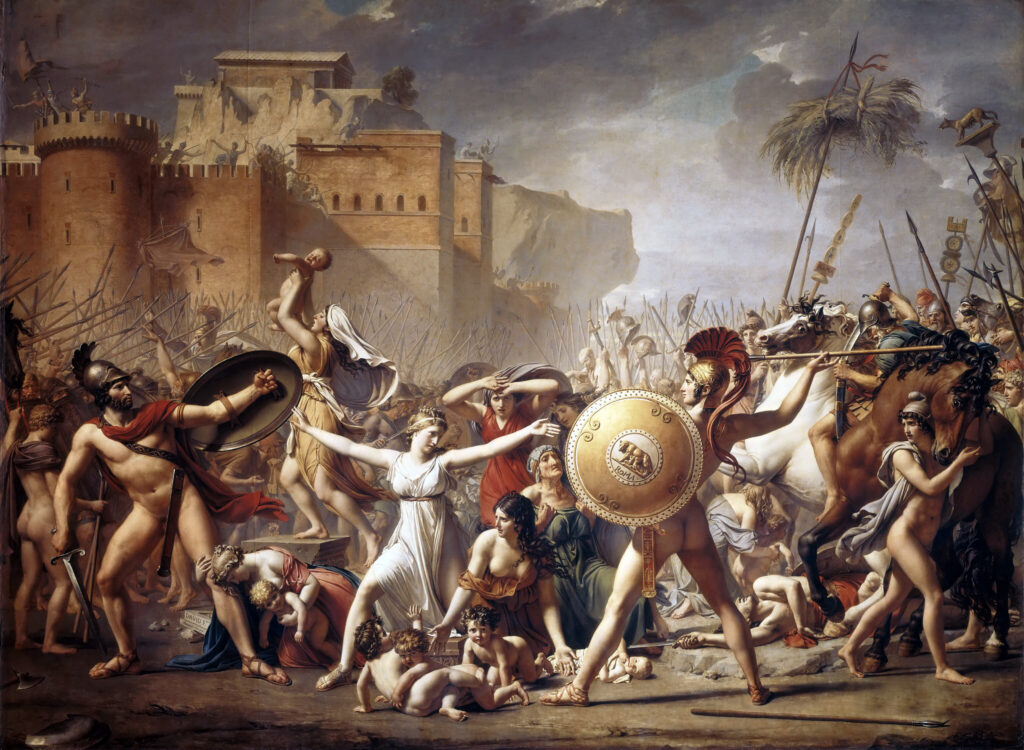
‘THE INTERVENTION OF THE SABINE WOMEN’ 1799.
Frenchman Jacques-Louis David’s (1748-1825) painting depicts a legendary event from Roman history in which the Sabine women intervened to stop a war between the Sabines and the Romans.
The painting shows the moment when the women rush between the soldiers to stop the conflict and reconcile the two sides. The composition features a strong contrast between the chaotic violence of the warriors and the calm determination of the women.
It’s an example of the neoclassical style of painting with its sharp lines and realistic figures and reflects David’s interest in ancient history and classical ideals.
I stood in front of this in The Louvre recently and it is one of those paintings where you say to yourself, in wonderment, ‘someone painted that?!!’
’The Intervention of the Sabine Women’
Jacques Louis David 1799
The Louvre Museum, Paris, France